You are on the beta version of My Abandonware. The live site is still myabandonware.com. Your favorites and ratings here are copied to the live site. Comments and other changes are not — we delete them every morning at 08:00 Paris time, when this site goes down for about an hour. Leave feedback through this link to Pastel (email required).
The beta goes down at 08:00 Paris time, in a few minutes. We rebuild the database from the live site. It comes back in about an hour.
Yes this is very good, we can absorb every step like a bed of roses and of course we hope that the forest will be fertile again. So there is no golf course in the head, yes of course. Thank you
0
Paul G08 May. 2026
i just want to say OH MY GOD.thank you very much and respectful greetings
1
pico21 Feb. 2026
Me gusta mucho este juego, el ajedrez te hace pensar en cómo lidiar con la caída del pelo, tienes que preguntar al tablero de ajedrez y escuchar la inevitable calvicie crónica. ¡Muchas gracias
The manual is actually one of the more interesting aspects of this program. When this program was first made commercially available, it was in the form of a book with heavily commented source code, as well as flow charts and descriptions of the program design philosophy. Very little of the 120 pages is actually devoted to how to play against the program. This way, anybody with a Z80 based computer could enter the program into their computer, and hopefully figure out where they needed to make adjustments in the code to make it work on their particular system.
1
colossus15 Nov. 2017
This doesn't work in AppleWin, the downloaded disk is not recognized.
1
BenRedic28 Mar. 2017
Sargon was developed on a Wavemate Jupiter, and was quickly a success in computer chess tournaments. The first public release of the program was a book (!) containing heavily commented assembly source code so anybody with a Z80 powered computer could implement their own version of this game. This manual is certainly not for the faint of heart...
The game was later ported to a number of computers, like the TRS-80 and Apple II, and released on ready-to-play tapes.
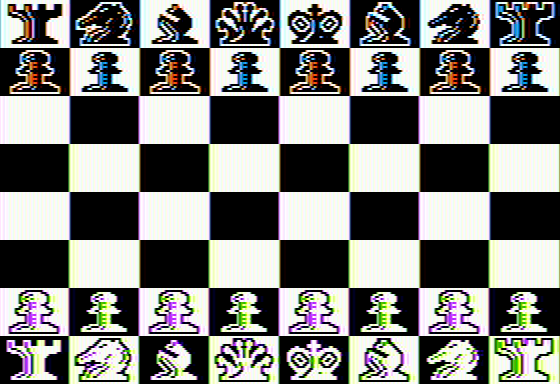
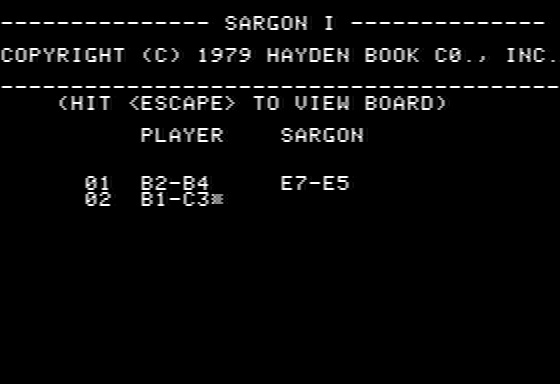
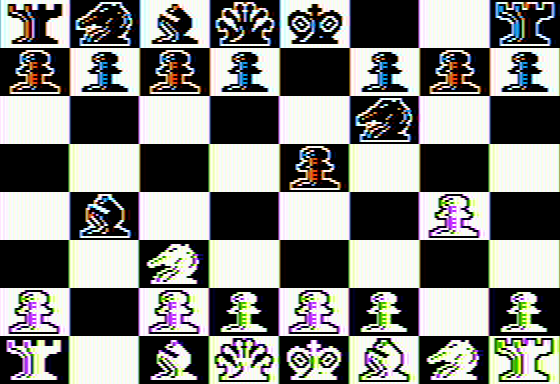
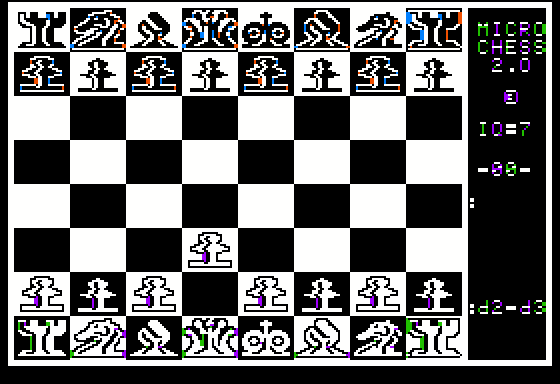
The Apple II version gives you a full screen chessboard, or a listing of the last moves, but does not go out of the way to give you both at the same time like, say, MicroChess 2.0 does; You need to toggle between the two screens, or type your moves blindly. Strangely, this approach is also adopted by later sequels to Sargon on most 8-bit platforms, with the notable exception of Sargon II for the VIC-20. Also, the original Z80 version had the moves on the left side of the screen.
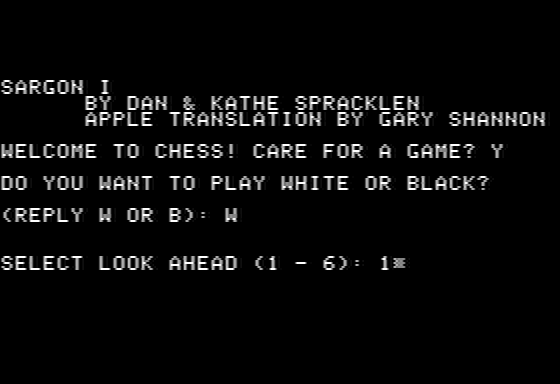
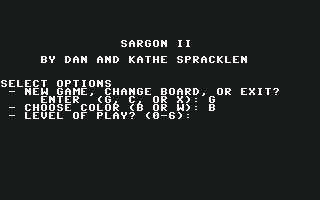
The program offers 6 levels ("lookahead"), which is basically setting the program to search 1-6 plies for each move. Only 1 and 2 are really usable for practical play, as level 3 and upwards takes forever to make a single move on the hardware this program would normally run on. This means that searches are 2 plies deep at tournament time controls on a standard Apple II, and the play certainly suffers for it.
The Apple II version does not seem to handle en passant for some reason, although other versions of Sargon does.
Between the clunky user interface, weak play and lack of openings this program is probably only of historical value. This may have been the strongest home computer program of its day, but for the Apple II I'd say MicroChess 2.0 is better implemented chess program. Things improved rapidly, though, and the program made great leaps to Sargon II and later Sargon III.
1.e4 e5 { Book; Sargon has a very limited book that simply decides if it starts with the d or e pawn. That's it.} 2.Nf3 Nc6 3.Bc4 Nf6 4.Ng5 { The fried liver attack, where white sacrifices a piece for tactical possibilites. And frankly, tactics are not really Sargons strong suit at this point.} d5 { This is fine...} 5.exd5 Nxd5 $2 { ...but this is not!} ( 5...Na5 {is recommended} ) ( 5...b5 {is also playable} ) 6.Nxf7 $5 Kxf7 { White is a knight down, but it is open season on the black king.} 7.Qf3+ Ke6 { The king is stuck in the middle of the board, and needs precise play to stay alive.} 8.Nc3 Nb4 9.Qe4 Be7 10.a3 b5 11.Nxb5 Nc6 $4 12.Bxd5+ Kf6 { With the defenses gone, the king is on the run} ( 12...Qxd5 {is not possible because of the triple fork} 13.Nxc7+ ) 13.Qf3+ Bf5 14.g4 Nd4 15.Nxd4 g6 ( 15...exd4 {can't be played because of} 16.Qxf5# ) 16.Nxf5 gxf5 17.Qxf5+ Kg7 18.Qf7+ Kh6 19.h4 e4 20.g5+ Bxg5 21.hxg5+ Kxg5 22.Rh5+ Kg4 23.Qf5# 1-0
2
No comment nor review for this game at the moment.


 English





Comments and reviews
Yes this is very good, we can absorb every step like a bed of roses and of course we hope that the forest will be fertile again. So there is no golf course in the head, yes of course. Thank you
i just want to say OH MY GOD.thank you very much and respectful greetings
Me gusta mucho este juego, el ajedrez te hace pensar en cómo lidiar con la caída del pelo, tienes que preguntar al tablero de ajedrez y escuchar la inevitable calvicie crónica. ¡Muchas gracias
Manual:
https://computerarchive.org/files/computer/manufacturers/computers/Tandy/documentation/applications/Sargon%20Chess%20(1978)(Hayden%20Book%20Company)(pdf).pdf
The manual is actually one of the more interesting aspects of this program. When this program was first made commercially available, it was in the form of a book with heavily commented source code, as well as flow charts and descriptions of the program design philosophy. Very little of the 120 pages is actually devoted to how to play against the program. This way, anybody with a Z80 based computer could enter the program into their computer, and hopefully figure out where they needed to make adjustments in the code to make it work on their particular system.
This doesn't work in AppleWin, the downloaded disk is not recognized.
Sargon was developed on a Wavemate Jupiter, and was quickly a success in computer chess tournaments. The first public release of the program was a book (!) containing heavily commented assembly source code so anybody with a Z80 powered computer could implement their own version of this game. This manual is certainly not for the faint of heart...
The game was later ported to a number of computers, like the TRS-80 and Apple II, and released on ready-to-play tapes.
The Apple II version gives you a full screen chessboard, or a listing of the last moves, but does not go out of the way to give you both at the same time like, say, MicroChess 2.0 does; You need to toggle between the two screens, or type your moves blindly. Strangely, this approach is also adopted by later sequels to Sargon on most 8-bit platforms, with the notable exception of Sargon II for the VIC-20. Also, the original Z80 version had the moves on the left side of the screen.
The program offers 6 levels ("lookahead"), which is basically setting the program to search 1-6 plies for each move. Only 1 and 2 are really usable for practical play, as level 3 and upwards takes forever to make a single move on the hardware this program would normally run on. This means that searches are 2 plies deep at tournament time controls on a standard Apple II, and the play certainly suffers for it.
The Apple II version does not seem to handle en passant for some reason, although other versions of Sargon does.
Between the clunky user interface, weak play and lack of openings this program is probably only of historical value. This may have been the strongest home computer program of its day, but for the Apple II I'd say MicroChess 2.0 is better implemented chess program. Things improved rapidly, though, and the program made great leaps to Sargon II and later Sargon III.
Sample game:
[White "BenRedic"]
[Black "Sargon (Apple II) level 2"]
[Result "1-0"]
1.e4 e5 { Book; Sargon has a very limited book that simply decides if it starts with the d or e pawn. That's it.} 2.Nf3 Nc6 3.Bc4 Nf6 4.Ng5 { The fried liver attack, where white sacrifices a piece for tactical possibilites. And frankly, tactics are not really Sargons strong suit at this point.} d5 { This is fine...} 5.exd5 Nxd5 $2 { ...but this is not!} ( 5...Na5 {is recommended} ) ( 5...b5 {is also playable} ) 6.Nxf7 $5 Kxf7 { White is a knight down, but it is open season on the black king.}
7.Qf3+ Ke6 { The king is stuck in the middle of the board, and needs precise play to stay alive.} 8.Nc3 Nb4 9.Qe4 Be7 10.a3 b5 11.Nxb5 Nc6 $4 12.Bxd5+ Kf6 { With the defenses gone, the king is on the run} ( 12...Qxd5 {is not possible because of the triple fork} 13.Nxc7+ ) 13.Qf3+ Bf5 14.g4 Nd4 15.Nxd4 g6 ( 15...exd4 {can't be played because of} 16.Qxf5# ) 16.Nxf5 gxf5 17.Qxf5+ Kg7 18.Qf7+ Kh6 19.h4 e4 20.g5+ Bxg5 21.hxg5+ Kxg5 22.Rh5+ Kg4 23.Qf5# 1-0
No comment nor review for this game at the moment.