


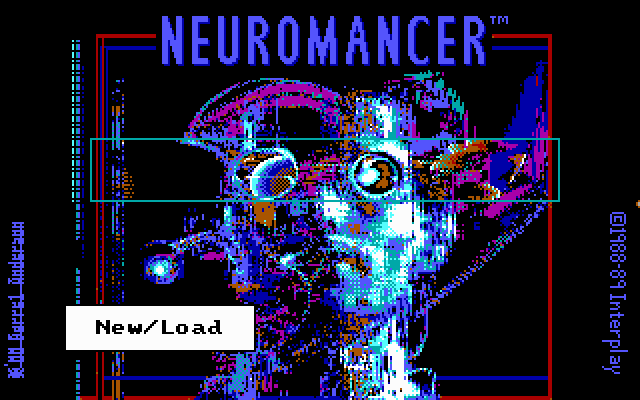
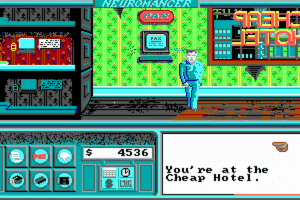
Neuromancer is one of the rare licensed games that understands the world it is adapting better than the plot. Instead of making you replay William Gibson's novel as Case, Interplay drops you into Chiba City as another broke console cowboy, nearly penniless and with your cyberspace deck sitting in a pawn shop.
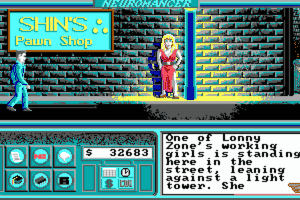
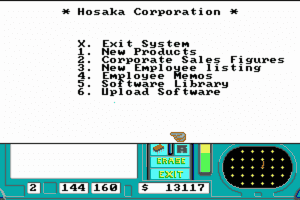
At first the game seems small. You walk between a limited number of locations, talk to people, make money and try to recover your equipment, but the real world of Neuromancer exists behind those places. Message boards, corporate databases, passwords, link codes, bank records, police files and pieces of software connect almost everything you do.
Hacking is not a side activity here. You break into systems, search records, alter information, steal software, clear debts and use one network to discover how to enter another. A conversation might reveal a name, that name may unlock a database, and the database may contain information that changes something you encountered much earlier.
Keeping a notebook is almost essential while playing. You'll need to remember names, passwords, addresses and strange pieces of information accumulate constantly, and much of the satisfaction comes from eventually understanding how they connect. The game expects you to behave less like an adventurer collecting objects and more like somebody investigating a network.
The skill chip system fits this world perfectly. Abilities such as Cryptology, Coptalk, Evasion, Hardware Repair, Sophistry and Psychoanalysis can literally be installed in your brain, then upgraded when better versions become available. Your character develops by acquiring knowledge rather than simply gaining experience points.
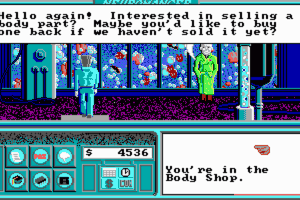
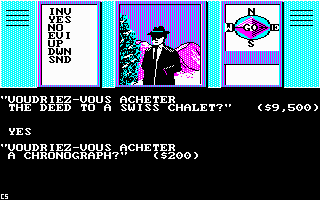
Even your body is part of the economy. The Body Shop will buy organs when you desperately need cash and sell replacements later if you can afford them. It is funny, grotesque and completely appropriate for a world where flesh, software and knowledge have all become commodities.
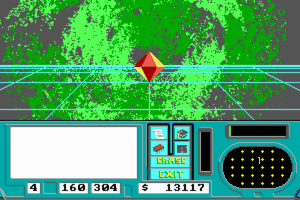
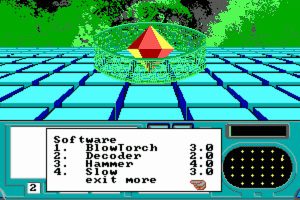
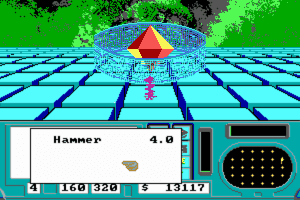
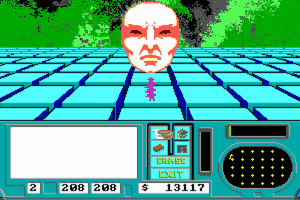
Eventually you gain access to cyberspace itself. The Matrix is visually primitive now, but the idea remains effective: systems become places, ICE becomes an enemy, software becomes weaponry and better hardware lets you penetrate deeper parts of the network. Artificial intelligences can even be attacked through psychological and philosophical weaknesses, turning strange skills such as Psychoanalysis and Sophistry into useful weapons.
The game does have serious frustrations. Conversations often require an exact keyword, so you can understand what to ask and still receive a useless answer because the game expects a slightly different name. Important clues can also be buried in conversations or database entries that seemed unimportant when you first encountered them.
Its tone is also much lighter than Gibson's novel. The book is cold and melancholy, while the game often becomes absurd, satirical and openly funny. Familiar names, corporations and concepts appear everywhere, but they are rearranged into a new story rather than used to recreate the novel scene by scene.
That loose adaptation is one of the game's strengths. Instead of asking how to reproduce Case's story, Interplay asked what somebody could actually do inside Gibson's world: buy knowledge, sell flesh, manipulate databases, steal information, install software and eventually enter cyberspace itself.
There have been prettier cyberpunk games and much smoother hacking games for sure, but few make information feel this valuable. Neuromancer understands that the fantasy of being a hacker is not really about watching code fly across a screen. It is about knowing something the system does not want you to know, then discovering what that knowledge allows you to do.
The history of Neuromancer began outside Interplay. A production company called Cabana Boy Productions obtained non print rights to William Gibson's novel, and Timothy Leary later became involved with the computer game rights. By the 1980s Leary had become fascinated with personal computers and interactive media, and he imagined a much larger multimedia interpretation of Neuromancer involving artists, musicians and other cultural figures.
Several earlier attempts failed before the project reached Brian Fargo and Interplay. Leary knew Fargo, and Interplay eventually turned the idea into a conventional computer game under producer Bruce Balfour, with Michael Stackpole contributing writing, Troy Miles programming the original version and Charles H. H. Weidman III producing the artwork.
One remnant of Leary's larger ambitions survived through Devo. The game uses a computer arrangement of “Some Things Never Change” from Total Devo, and Troy Miles later recalled visiting the band's studio and meeting Mark Mothersbaugh. Licensed popular music inside a computer role playing game was still unusual in 1988.
William Gibson was consulted but did not design the game. In a contemporary interview he explained that Interplay had actually offered him more opportunity to contribute, but he did not feel he understood how to create material that worked as an interactive game. Miles later remembered Gibson having no practical development role and did not believe he ever played the finished product.
As a plot adaptation, the game is very loose. The player does not become Case, and the story does not recreate his recruitment, Molly's role or the Straylight operation. Instead it borrows places, characters, corporations and concepts such as Chiba City, the Chatsubo, Dixie Flatline, the Panther Moderns, Wintermute, Neuromancer and Tessier Ashpool, then builds a separate adventure around them.
Its deeper fidelity lies in the systems. Gibson's cyberspace becomes a navigable environment, ICE becomes security, software becomes equipment, skill chips make knowledge purchasable, corporations become networks that can be entered and altered, and the human body becomes another commodity. The game adapts how Gibson's world works rather than simply reproducing what happens in the novel.
That approach also connects the fictional future to real computer culture of the late 1980s. The PAX network, passwords, message boards, private systems and addresses resemble the BBS world that actual computer users already knew. Gibson had imagined cyberspace from the outside, while Interplay's developers translated it through the technology and network culture they were living with.
The shift into the Matrix was especially unusual for 1988. Instead of treating hacking only as text commands or database menus, the game eventually turns cyberspace into a place where the player moves through systems, fights ICE, upgrades software and confronts artificial intelligences. This gave visual and mechanical form to an idea that had existed mainly in fiction.
Neuromancer received strong critical recognition, including Computer Gaming World's Adventure Game of the Year award, but it was not one of Interplay's major commercial hits. A planned game based on Count Zero never appeared, and titles such as Battle Chess attracted far more mainstream attention.
Its direct influence on later games is difficult to prove, so it is safer to describe it as unusually early rather than as the clear ancestor of everything that followed. Years before cyberpunk role playing games routinely combined hacking, cybernetic upgrades, corporations, software and alternate digital spaces, Neuromancer was already experimenting with all of them inside the same game.
Its fan culture became part of its legacy. Players exchanged passwords, addresses and solutions through Usenet, then preserved maps, database information, AI weaknesses and walkthroughs on personal websites and later fan archives. A fan remake was even attempted during the 2000s, although it was never completed.
There is something fitting about the way the game survived. A game built around scattered information, hidden systems and people exchanging access codes ended up being preserved through Usenet posts, fan pages, old walkthroughs and fragments of the early Web.
Source: Itai’s Game Preservation Research
 English






Comments and reviews
@TWOFACETWO Read. The. Manual.
How are we meant to get past the PAX verification code?
The PC version looks terrible though. The Amiga version is by far the best looking version and I highly recommend playing that version in WinUAE or on a real Amiga.
Would be a mind blower to see what could be done along the same lines with todays tech. Gawd the graphics alone would be out of this world. Not to mention what they could do with the speed, space, and so on. Just as long as they didn't get to in depth where you needed multiply PHD to simple tell it to send this virus :^D
I still have this game kicking around somewhere in my house. No drive that'll load it, of course and the disk has probably derezzed by now.
I played this game exactly as it should be played; I hacked the save file.
I also ended up calling the developers after I found a possible bug. It was an interesting one. When I faced the AI that sounds like Dirty Harry, I fired Warrant 1 at him and he died instantly. He was the only AI that did so.
This was the first game my brother and I ever binged together. In the days before cheat codes, websites and gaming magazines, you had to figure this one out all on your own. Being the younger brother, I was so proud when I figured out that laying a virus down first, then attacking was the key to defeating the earlier bases. This game is a happy memory of one of the few times he and I got along.
Being familiar with Gibson’s novel when this game came out, it was one of the best games of the time. It had such an in depth cyber future for a game at that time. It just inspired us to hack into more bbs systems at the time!
how do you actually save the game in this game? can someone teach me how on DOS version?
One of the most unique Western RPG's ever made. The twist on the conventional RPG mechanics is refreshingly novel - instead of a wizard, you are a hacker. Instead of a dungeon, you are fighting in a virtual cyberspace. Instead of fighting dragons, you are fighting AI and other hackers. Instead of casting spells, you are sending viruses and performing malicious attacks. And so forth.
At first it feels like a tiny world, with only a few "real world" locations to go to. But then the game's virtual reality universe opens up and the game slowly reveals the plot's depth. I enjoyed exploring hacked email servers and piecing the plot together from the dialog it created.
This game was a huge pioneer thematically - how many games before 1989 dealt with cybernetic augmentation, AI, hacking, in-game virtual worlds, et cetera, in a corporatist dystopia setting? Not surprising if you're familiar with the book or the cyberpunk genre, but the game world never saw anything close to such a collection of these themes before Neuromancer came out 30 years ago, and arguably hasn't seen a better execution of them since.
I guess there's plenty of references to neuromancer in the shadowrun franchise. In the SNES version, even the main protagonist's name is armitage..
I review Neuromancer here: http://youtu.be/K37SXsjk19o
Tron - Actually, this game is based on the novel of the same name by William Gibson - one of the great daddies of Cyberpunk. Shadowrun takes elements from a lot of things, particularly Gibson's Cyberpunk stuff.
So, this game is based on shadow run board game, and shadow run genesis is based on this game. Mind fcuk!!!!
I memorized the 'cheat' manual when I originally purchased this (for my Commodore 128D)---going to be FUN playing it again! (...I still use 'Black ICE' security on my PC... )
I'm pretty sure Uplink is a waaay better hacker game, but comparing the two would be like comparing apples and pears..
thank you peace
This game changed my life. Literally if you look at pictures before and after I turned from "Bobby Brown" to "Dennis Rodman" and everything that went along with that thinking.
this game is amazing. i wish more had been done with this franchise.
No comment nor review for this game at the moment.