You are on the beta version of My Abandonware. The live site is still myabandonware.com. Your favorites and ratings here are copied to the live site. Comments and other changes are not — we delete them every morning at 08:00 Paris time, when this site goes down for about an hour. Leave feedback through this link to Pastel (email required).
The beta goes down at 08:00 Paris time, in a few minutes. We rebuild the database from the live site. It comes back in about an hour.
The codebase written by Bruce Artwick for FS II was at least in partial use through Microsoft Flight Simulator 6.1 (aka Microsoft Flight Simulator 98) and possibly in Flight Simulator 2000.
The Amiga, Atari ST and the Macintosh Versions are probably more accurately considered version 3.X rather than the 1.0 they were published as, and appear to have shared a lot in common with Microsoft Flight Simulator 3.X and 4.X which were, of course, written by Sublogic before Sublogic was acquired by Microsoft.
The scenery disks were probably among the first add-on content for commercial games.
0
GoldenArcade(SSP) 80sGamer18 Mar. 2019
Please note for possible correction:
subLOGIC Flight Simulator II, v1.0 .. is a 1983 work for the Apple ][. :) (Not 1984)
3
GoldenArcade(SSP) 80sGamer18 Mar. 2019
I first played this on the Apple ][. Not the prettiest of them, but one of (if not THE) earliest computer flight simulators, subLogic's game was picked up by Microsoft and spawned several future versions, past 10 ("X").
This old original also came with a "dogfighter" simulation, allowing you to fly the Sopwith Camel and go up against an enemy plane to try and shoot it down..
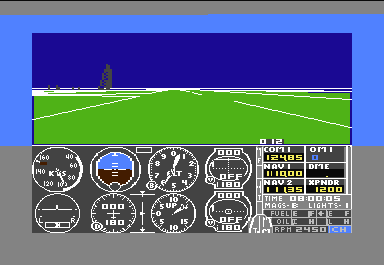
FlightSim always started you at Merrill C. Meiggs Field, in Illinois, and one of the closest options for your first flight was to head to Chicago O'Hare International!
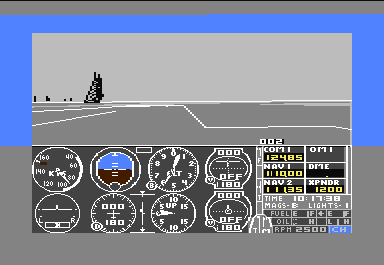
Before Scenery Disks were ever made, only the odd landmark or two were included; here, we got the Sears Tower of Chicago as a landmark.
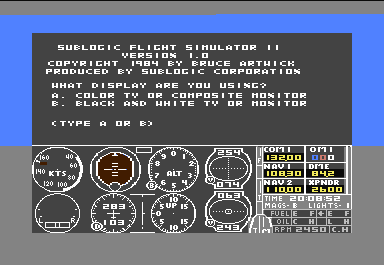
An excellent first flight simulator for the consumer personal computer, it taught most of the basics for both Visual and Instrument Flight Rule (VFR & IFR), allowing you to familiarise with the use of NAV beacons, VOR/DME, and the GlideSlope setup for ILS-assisted landing, including OMI (Outer, Middle, Inner) markers, etc.
Basic standard flight instruments featured: Windspeed (knots), Horizon/Level, Altitude, Rotation (roll), Heading (compass), and Rate of climb/descent.
Flight surfaces & controls covered: Ailerons by Yoke (for pitch & roll), Tail fin by Rudder (for yaw & taxiing), Flaps (for larger flight surface area), Trim control (for fine-tuning / correction), Throttle (obvs for speed control), Radio & Transponder setting, use of Heat for colder-condition flying, and Lights of course for Night flying.
The Game Manual was quite comprehensive, and was accompanied by realistic Flight Charts of the included areas, featuring all required information such as Runway Names, Headings, & Altitudes; ILS availability; and frequencies for all marked NAV beacons.
I'd say this is a Landmark game, as it really set the stage for computer flight simulators, including combat dog-fighters, since 1983, and also contributed hugely to space flight simulators to come after it..
4
fdisk09 Nov. 2015
manual amiga: EDIT: Thx fdisk !
-6
No comment nor review for this game at the moment.





 Manual 3
 RefCard 3

 English





 German

Comments and reviews
The codebase written by Bruce Artwick for FS II was at least in partial use through Microsoft Flight Simulator 6.1 (aka Microsoft Flight Simulator 98) and possibly in Flight Simulator 2000.
The Amiga, Atari ST and the Macintosh Versions are probably more accurately considered version 3.X rather than the 1.0 they were published as, and appear to have shared a lot in common with Microsoft Flight Simulator 3.X and 4.X which were, of course, written by Sublogic before Sublogic was acquired by Microsoft.
The scenery disks were probably among the first add-on content for commercial games.
Please note for possible correction:
subLOGIC Flight Simulator II, v1.0
.. is a 1983 work for the Apple ][. :)
(Not 1984)
I first played this on the Apple ][. Not the prettiest of them, but one of (if not THE) earliest computer flight simulators, subLogic's game was picked up by Microsoft and spawned several future versions, past 10 ("X").
This old original also came with a "dogfighter" simulation, allowing you to fly the Sopwith Camel and go up against an enemy plane to try and shoot it down..
FlightSim always started you at Merrill C. Meiggs Field, in Illinois, and one of the closest options for your first flight was to head to Chicago O'Hare International!
Before Scenery Disks were ever made, only the odd landmark or two were included; here, we got the Sears Tower of Chicago as a landmark.
An excellent first flight simulator for the consumer personal computer, it taught most of the basics for both Visual and Instrument Flight Rule (VFR & IFR), allowing you to familiarise with the use of NAV beacons, VOR/DME, and the GlideSlope setup for ILS-assisted landing, including OMI (Outer, Middle, Inner) markers, etc.
Basic standard flight instruments featured:
Windspeed (knots), Horizon/Level, Altitude,
Rotation (roll), Heading (compass), and Rate of climb/descent.
Flight surfaces & controls covered:
Ailerons by Yoke (for pitch & roll),
Tail fin by Rudder (for yaw & taxiing),
Flaps (for larger flight surface area),
Trim control (for fine-tuning / correction),
Throttle (obvs for speed control),
Radio & Transponder setting, use of Heat for colder-condition flying, and Lights of course for Night flying.
The Game Manual was quite comprehensive, and was accompanied by realistic Flight Charts of the included areas, featuring all required information such as Runway Names, Headings, & Altitudes; ILS availability; and frequencies for all marked NAV beacons.
I'd say this is a Landmark game, as it really set the stage for computer flight simulators, including combat dog-fighters, since 1983, and also contributed hugely to space flight simulators to come after it..
manual amiga:
EDIT: Thx fdisk !
No comment nor review for this game at the moment.